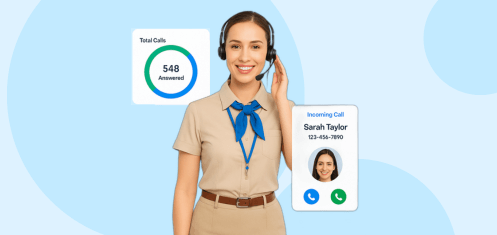
Large organizations need a communication system that can support multiple departments, branch offices, and distributed teams without creating operational complexity. An enterprise VoIP phone system brings business calling, internal extensions, and call management together through a centralized communication platform.
Creative IT Solutions helps organizations implement enterprise VoIP solutions with flexible cloud-hosted, on-premise, and hybrid deployment options. From advanced call routing and centralized administration to analytics and business integrations, the system can be designed around your organization's communication requirements.
Whether you operate across multiple offices or manage a large workforce, the right enterprise phone system helps streamline communication, improve visibility, and support business growth.
An enterprise VoIP phone system is a business communication solution that uses Internet Protocol (IP) networks to manage voice calls across multiple departments, offices, and locations. Instead of relying entirely on traditional telephone lines, organizations can manage business calls through a centralized IP-based communication infrastructure.
An enterprise VoIP system allows organizations to:
Enterprise VoIP can be deployed through cloud-hosted, on-premise, or hybrid infrastructure, depending on an organization’s technical requirements, security policies, and operational preferences.
Unlike standard business phone services, enterprise VoIP solutions are designed to support complex communication environments, centralized administration, and large-scale organizational requirements.
As organizations expand across departments, offices, and regions, managing business communication becomes increasingly complex. Traditional phone systems can make it difficult to maintain consistent calling processes, centralized control, and visibility across the organization.
Some common enterprise communication challenges include:
Maintaining legacy PBX infrastructure, separate telephone systems, and international calling services can increase communication expenses across multiple locations. Businesses with significant overseas calling requirements can also explore our Best VoIP for International Calls for Businesses to learn about business-focused international calling solutions.
Adding new employees, departments, or branch offices may require additional hardware, configuration, and deployment effort.
Traditional office-based phone systems can make it difficult for employees working remotely or across different locations to access consistent business communication services.
Different offices operating separate phone systems can create administrative complexity and make it harder for IT teams to manage extensions, permissions, and call routing centrally.
Without centralized call analytics, organizations may struggle to monitor call volumes, identify communication bottlenecks, and evaluate team performance.
Managing multiple phone systems, user accounts, network requirements, and communication policies can increase the workload for enterprise IT teams.
An enterprise VoIP phone system helps address these challenges through centralized call management, flexible deployment options, and software-based communication controls.

Our enterprise VoIP phone system brings essential business communication capabilities together to help organizations manage calls, users, and multiple locations through a unified platform.
Connect headquarters, branch offices, regional teams, and remote employees through a centralized enterprise communication system.
Configure call distribution rules, department-based routing, business hours, and call forwarding to direct incoming calls efficiently.
Create and manage employee extensions, user permissions, departments, and calling policies from a central administration platform.
Monitor call volumes, call duration, waiting times, and other available communication metrics to understand calling activity and operational performance.
Set up automated voice menus to help callers reach the appropriate department or team without unnecessary transfers.
Connect supported CRM, ERP, helpdesk, and business applications to streamline call-related workflows and improve access to customer information.
Establish structured internal calling across departments, offices, and locations using customized extension and dial-plan configurations.
Support high-quality voice communication and compatible video capabilities to facilitate clearer conversations and collaboration.
Apply appropriate authentication, user permissions, network controls, and supported security protocols to help protect business communication.
These enterprise VoIP features help organizations maintain centralized control, improve communication workflows, and manage calling requirements across complex business environments.
An enterprise VoIP phone system helps large organizations simplify communication, manage multiple locations, and maintain better control over business calling operations.
Reduce dependence on traditional telephone infrastructure and manage business calling through a centralized VoIP platform. Actual savings depend on usage, deployment, and service requirements.
Manage users, extensions, call routing, and communication settings across departments and branch offices through a centralized administration system.
Add users, extensions, and locations as your organization grows, subject to the capacity and configuration of the selected VoIP platform.
Allow employees to communicate through supported desk phones, computers, and mobile devices, helping teams stay connected across different locations.
Choose a cloud-hosted, on-premise, or hybrid deployment model based on your organization’s infrastructure, security requirements, and operational preferences.
Use available call reports and analytics to review communication activity, monitor calling patterns, and identify opportunities to improve call handling.
Get assistance with system configuration, troubleshooting, maintenance, and communication infrastructure management based on your agreed support plan.
With the right enterprise VoIP deployment, organizations can build a more flexible and manageable communication environment that supports their operational needs.
Creative IT Solutions follows a structured deployment process to help organizations implement an enterprise VoIP system that aligns with their communication requirements and existing infrastructure.
We assess your organization's communication needs, including the number of users, departments, branch locations, existing phone infrastructure, and expected call volumes.
Based on the assessment, we design a suitable VoIP architecture and recommend a cloud-hosted, on-premise, or hybrid deployment model.
We configure the selected VoIP platform, including extensions, user accounts, call routing, IVR menus, permissions, and other required communication features.
Where supported and included in the project scope, we configure integrations with compatible business applications and test call flows, connectivity, audio quality, and system functionality.
We help administrators and employees understand how to use the system, manage extensions, handle calls, and access relevant features.
After deployment, we provide support according to the agreed service arrangement to help address technical issues, configuration changes, and evolving communication requirements.
Our deployment approach focuses on careful planning, reliable configuration, and a smooth transition to your new enterprise communication system.
Choosing an enterprise VoIP provider requires more than selecting a phone system. Organizations need a technology partner that understands business communication, network infrastructure, and the operational requirements of large teams.
Creative IT Solutions aims to build long-term technology partnerships by delivering enterprise communication solutions that align with each organization’s requirements.
Enterprise VoIP systems can support organizations with multiple departments, branch offices, and distributed teams. The deployment can be tailored to the communication workflows and operational requirements of different industries.
Enterprise VoIP solutions can be adapted to different business environments based on the organization’s size, infrastructure, and communication requirements.
Ready to modernize business communication across your organization?
Creative IT Solutions can help you evaluate your communication requirements and identify an enterprise VoIP phone system that fits your business infrastructure, workforce, and operational needs.
Whether you are upgrading an existing PBX, connecting multiple office locations, or planning a new communication infrastructure, our team can help you plan the next steps.
Share your requirements with our team to discuss deployment options, system capabilities, and implementation planning.
Contact Creative IT Solutions today to discuss your enterprise VoIP requirements.
Yes. An enterprise VoIP system can connect headquarters, branch offices, and remote teams through a centralized communication platform. The exact setup depends on the selected deployment model, network infrastructure, and system configuration.
Enterprise VoIP security depends on the platform, network configuration, and security controls implemented. Appropriate measures can include encryption, authentication, access permissions, network security, and regular system updates.
Many enterprise VoIP platforms support integrations with CRM, ERP, helpdesk, and other business applications. Integration availability depends on the selected platform, supported APIs, and project requirements.
Yes. Depending on your organization's requirements and the selected platform, an enterprise VoIP system can be deployed as a cloud-hosted, on-premise, or hybrid solution.
Implementation time depends on the number of users, office locations, existing infrastructure, integrations, and configuration requirements. A deployment timeline can be estimated after assessing your organization's requirements.
Yes. Supported VoIP platforms can allow employees to make and receive business calls through compatible desk phones, computers, or mobile devices, subject to system configuration and network availability.
In many cases, organizations can migrate from traditional PBX infrastructure to an enterprise VoIP solution. The migration approach depends on the existing equipment, telephone numbers, network infrastructure, and compatibility requirements.